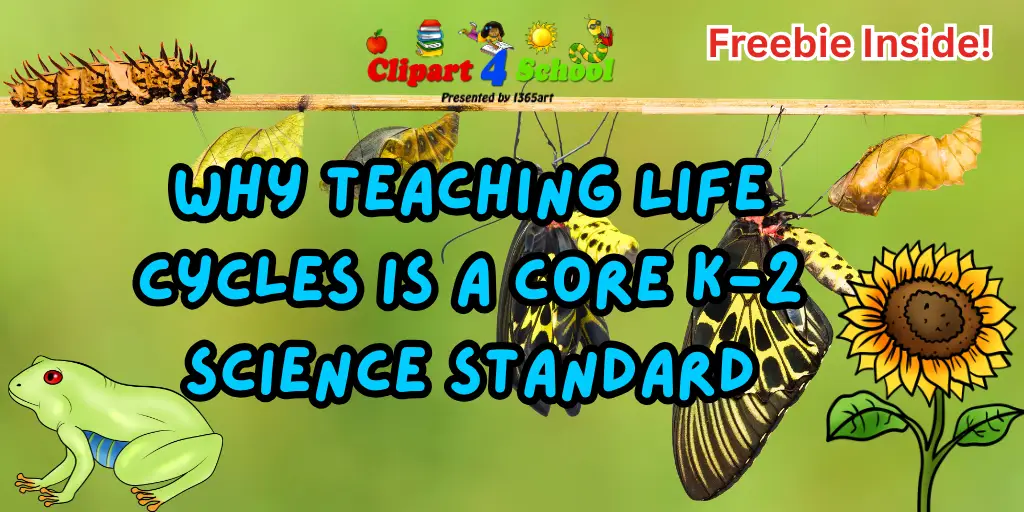
If you’ve ever looked at your grade-level science standards and wondered why life cycles appear year after year, don’t worry. You’re not alone here! From frogs and butterflies to beans and sunflowers, the concept of growth and change is a staple in kindergarten, first and second grade classrooms.
Teaching life cycles is actually one of the most powerful ways to introduce your young students to the wonders of biology, observation, and the natural world. I’d like to explore more why life cycles are a core K-2 science standard, what the research says, and how you can bring this topic to life with some of your own hands-on activities and high-quality visual resources. Keep reading to learn more!
1. The “Why” Of It All
First, let’s talk about the “why.” In most K-2 science frameworks—including the Next Generation Science Standards (NGSS)—students are expected to understand that all living things have predictable life cycles. The specific performance expectation under LS1.B (Growth and Development of Organisms) states that young learners should be able to describe patterns of growth and change in organisms, from birth to adulthood.
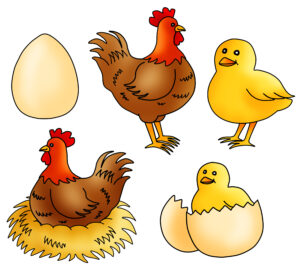
Now, that might sound pretty simple, but it’s actually a HUGE cognitive leap for your students. A five-year-old may not be able to automatically connect a tiny egg to a full-grown chicken. By explicitly teaching life cycles, we help children build a mental timeline of how living things change over time and build a better understanding of biology at the same time. This basic understanding sets the stage for later concepts like heredity, ecosystems, and even human development eventually!
2. Beyond The Standard
Beyond the standards, educating students about life cycles offers four major benefits especially for very young students.
The first is the development of observation skills. When children watch a tadpole grow legs or a seed push out a root, they are practicing careful, long-term observation. They learn to notice small changes, compare stages, and ask questions like “What happens next?” These are the same skills that real scientists use. Second, life cycles introduce rich academic vocabulary in a natural way. Words like larva, pupa, germination, seedling, and metamorphosis become meaningful when attached to actual pictures and sequences. Instead of memorizing definitions, children learn the words by using them to describe what they see.
Third, teaching life cycles helps cultivate respect for life and environmental awareness at an early age. When a first grader watches a caterpillar turn into a butterfly, something magical happens! They begin to see that even small creatures go through incredible transformations. This often sparks empathy, curiosity and a desire to protect nature. Many teachers report that life cycle units are when students start bringing in found insects, asking to plant a classroom garden, or begging for a class pet. That’s not a coincidence—it’s the curriculum working. Fourth, life cycles are naturally cross-curricular. You can easily integrate literacy (sequencing stories like The Very Hungry Caterpillar), math (measuring plant growth and creating simple graphs), and art (drawing each stage). This makes life cycles a teacher’s best friend when you need to cover multiple subjects in one engaging unit.
3. Visualize It!
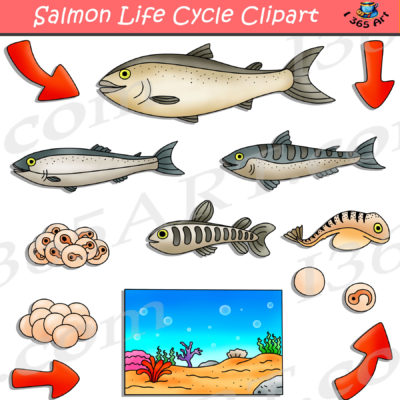
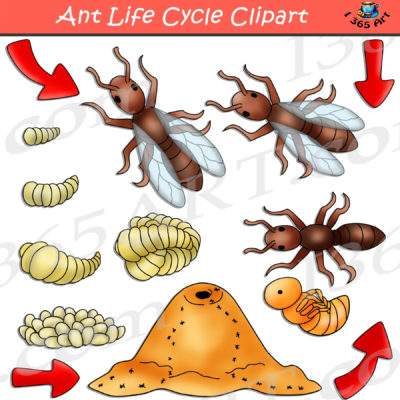
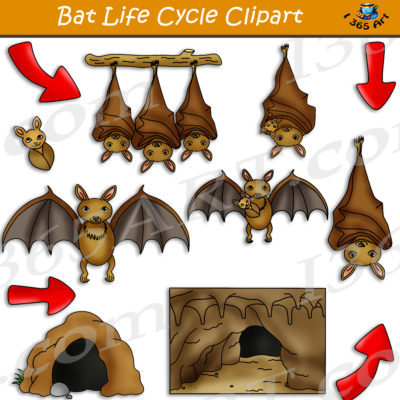
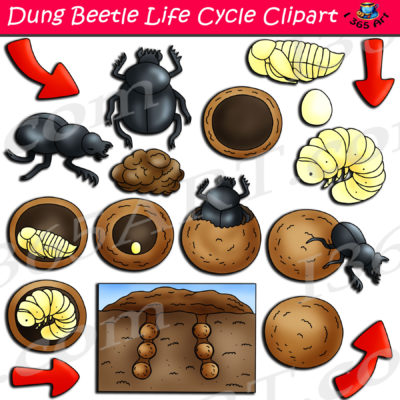
Now, here’s where visual resources come in to play! The most effective way to teach life cycles is through visuals and hands-on activities. Abstract descriptions don’t stick with young students, but bright, clear images absolutely do! That’s why I created a full collection of life cycle clipart sets designed specifically for K-2 educators.
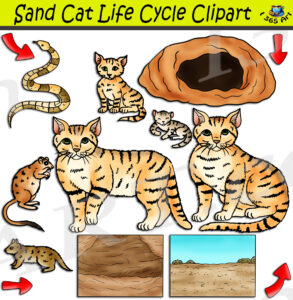
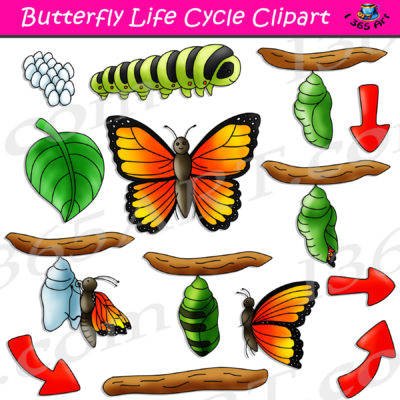
Each set includes high-resolution PNG images of every stage, from egg to adult, plus arrows, labels, and optional backgrounds. For example, my Butterfly Life Cycle Clipart Set includes the egg, caterpillar (larva), chrysalis (pupa), and adult butterfly. I also have a more advanced Monarch Butterfly Life Cycle Clipart Set for more advanced teaching and higher grades!
You can use these images to create a classroom anchor chart, a sequencing center with laminated cards or even a life cycle “hat” where students glue the stages in order around a sentence strip. The Frog Life Cycle Clipart Set covers eggs, tadpole, tadpole with legs, froglet and adult frog. It’s perfect for interactive notebook foldables or a cut-and-paste worksheet.
And the Sunflower Life Cycle Set includes seed, sprout, seedling, young plant and flowering plant. Use it for labeling activities, a classroom display, or a student-created mini-book.
I also have a huge variety of more clipart sets that are not found here on Clipart 4 School. You can find my full collection of clipart sets over at Teachers Pay Teachers or by signing up for an Annual Clipart Membership Subscription for my full catalogue!
4. No-Prep Activity Ideas
Here are three no-prep activities you can build with these clipart sets.
Activity 1: The Sequencing Station Print and laminate four to six cards showing the stages of one life cycle. Place them in a small basket with a simple instruction card: “Put the cards in order from beginning to end.” This becomes an instant science center that students can work on independently while you pull small groups.
Activity 2: Interactive Notebook Foldable Print a set of stage images at a reduced size. Have students cut them out and glue them in their science notebook in the correct order. Under each image, they write one fact (or copy a word label). This creates a lasting reference they can review all year.
Activity 3: Life Cycle Wheel Craft Give each student two paper plates. On the bottom plate, cut out a small window. On the top plate, glue the clipart images in a circle around the edge. Students attach the plates with a brass fastener so they can spin the top plate and reveal each stage through the window. It’s simple, memorable, and great for fine motor practice.
5. The Bottom Line
Teaching life cycles isn’t just about meeting a standard. It’s about sparking curiosity, building vocabulary, and helping children see the world as a place of constant, beautiful change. When you use clear, engaging visuals in your lessons, you make abstract ideas concrete. You give every student—regardless of reading level—a way to participate and understand.
Bonus: Free Clipart Set Below!
To help you get started, I’ve provided a Free Life Cycle clipart set below.
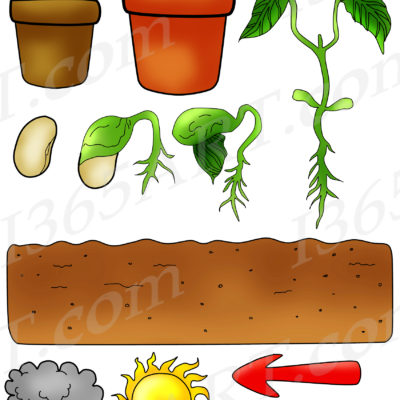
Click here to download your free Lima Bean life cycle clipart set!
Happy crafting and may your classroom be full of growing things!
Latest Products From Clipart 4 School
-

Plant Life Cycle Clipart – Lima Bean Set – Color & Black/White
$5.00 -
Butterfly Life Cycle Clipart Bundle
$5.00 -
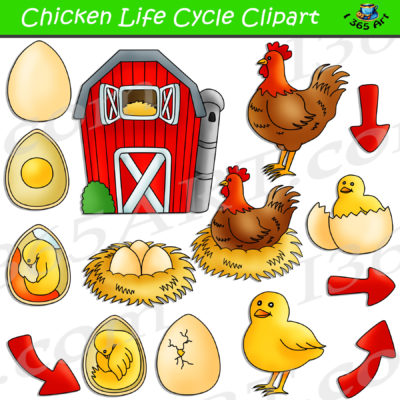
Chicken Life Cycle Clipart Bundle
$5.00 -
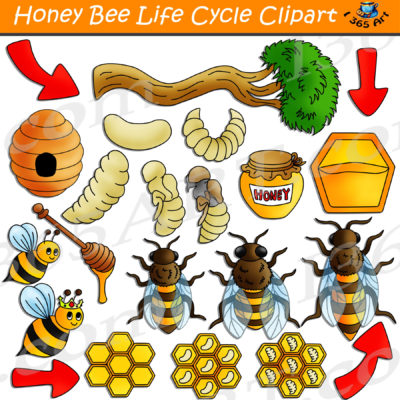
Honey Bee Life Cycle Clipart Bundle
$6.00 -
Salmon Life Cycle Clipart Bundle
$5.00 -
Ant Life Cycle Clipart Bundle
$5.00 -
Bat Life Cycle Clipart Bundle
$5.00 -
Dung Beetle Life Cycle Clipart Set
$5.00